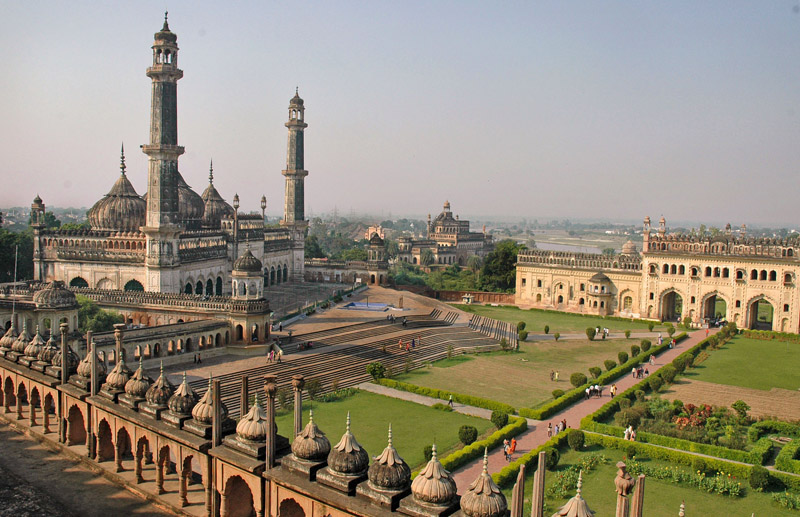
Exploring Lucknow
Area : 79 sq km. Altitude : 123 m above sea level Rainfall : 44 cms (June-Sept). Climate : Summer (Degree C): Max 36.6, Min 25; Winter (Degree C): Max 21.1, Min 11.1 Languages : Hindi, Urdu, English Best time to Visit : October - March STD Code : 0522
History of Lucknow
The origin & history of Lucknow is truly intriguing not just to the historians but also to the common man. The history of Lucknow can be traced back to the ancient times of the Suryavanshi Dynasty. It is said that Lakshmana, who was the brother of Lord Rama, laid the foundation of the ancient city. This was near the Gomti River on an elevated piece of land. It was then called Lakshmanpur. However, the city came into notice only during the 18th Century. To know more about Lucknow history, read further the information given below.
It was during the year 1720 when the great Mughal emperors began to appoint Nawabs in order to ensure smooth administration in the province. In the year 1732, Mohammad Amir Saadat Khan was appointed as the viceroyal of Awadh, in which Lucknow was a major province. It was then that the powerful dynasty of the Nawabs, which changed the history of this unknown place. Under the rule of the Nawabs, Lucknow flourished like never before. After 1755, Lucknow grew by leaps and bounds under the rule of the fourth Nawab Asaf-ud-Daula. Lucknow flourished in each and every aspect, which includes poetry, dance, music and the other finer aspects of the lifestyle of Lucknow.
It was when the British came to India that Lucknow was made into an administrative capital. There were many uprisings during the British rule by Indian radicals and many ghastly incidents left Lucknow with bad memories. However, after independence Lucknow was declared the capital of the state of Uttar Pradesh by the Government of India. Since then it has progressed beautifully, merging skillfully the past with the present.
Sightseeing In Lucknow
Kaiserbagh is Wajed Ali Shah's most magnificent and spacious contribution to Lucknow. This sprawling complex consisted large, medium and small structures in the form of large rows of living quarters, royal mansions, baradaris, and cupolas. Almost half of the Kaiserbagh has withstood the vagaries of the time and has somewhat survived. Few important structures comprising Kaiserbagh are:
It was a massive gate on the northern side where Awadh Gymkhana is located now.
At the end of China Bazar with built-in quarters on the top.
This was the royal garden surrounded on three sides by the king's apartments. The main building was Shahenshah Manzil which faced the south. It is one of the buildings which now stands in front of the Lucknow Development Authority office.
This Baradari was near Huzoor Bagh. It was the Baradari where Prince Brijis Qadar was installed on the royal throne on 12th July 1857.
This was behind Shahenshah Manzil which was used as the 'reception' for waiting courtiers and visitors.
Not far from the clock tower is the picture gallery which has a collection of contemporary oil paintings of the Nawabs of Avadh. A little pond in front of the gallery has both hot and cold water in it.
is in old Lucknow. It's a market with an old-world charm. Crowded with shops selling everything from truck tyres to mouthwatering biryani, it has the look of a permanent fair.
was built by Amjad Ali Shah. He was buried at Imambara Sibtainabad in the western part of Hazratganj.
Overpowering in dimensions yet aesthetically designed, Charbagh Railway Station was built in 1914 and combines the best of Rajasthani and Mughal architecture. True its name, it is said that four gardens were here at the time of the Nawabs. It gives an ideal, traditional warm welcome to every visitor.
Kothis
Plan your visit
A useful journey leaves room for local discoveries. Start with these essentials, then verify operational details from primary sources.
Pick a few nearby cities or landmarks rather than trying to cover a whole state in one short trip.
Compare temperature, rainfall and festival periods for the specific part of the region you will visit.
Include time for food, museums, crafts and the places that matter to local communities.
Confirm transport, permits, accommodation and opening dates directly from reliable sources.
More journeys to discover

Frequently asked questions
What is Lucknow known for?
Lucknow is explored in this guide through its local heritage, visitor attractions, culture and images. The highlights and linked articles below offer starting points for your itinerary.
How should I plan a first visit to Lucknow?
Choose a few nearby highlights in Lucknow, group them by area and allow flexibility for travel, meals and rest. Confirm the latest access information with official providers.
When is the best time to visit Lucknow?
The most comfortable time depends on local weather, festivals and your planned activities. Check current seasonal forecasts and any attraction-specific closure notices for Lucknow.
Where can I confirm ticket prices and opening times in Lucknow?
Check the official tourism authority or the individual venue before departure. This page intentionally does not repeat potentially outdated prices or hours.
Is this Lucknow guide updated?
This page was rebuilt from legacy IndiaCityTrip content on October 23, 2026. Older descriptive material has been reorganized; operational details still require direct verification.