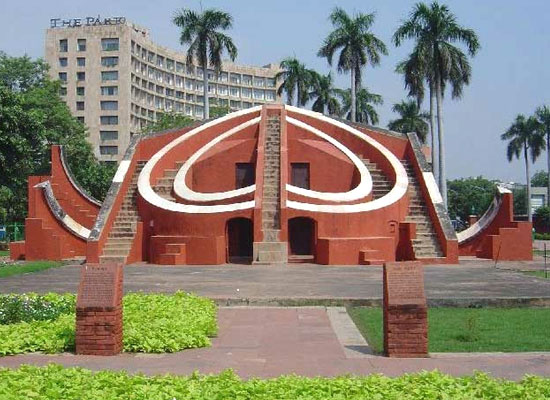
Exploring History and Significance of Jantar-Mantar
Jantar-Mantar was built in 1727 - 1734 by the King of Jaipur Maharaja Jai Singh II . Five such observatories were built during that time including the observatories in Jaipur and Delhi . Among those five, the observatory of Jaipur is the largest one and is the perfect observatory around. The monument is designed smartly and tactfully to define the great time of the day and the seasons of the year. It has 14 largely built instruments and all of them are designed to tell different astronomical assumptions. The monument displays the extraordinary artwork of the people of ancient times .
Jantar-Mantar has a master instrument which is approximately 27 m in height. This is called the Giant Sundial . This instrument displays the time of the day up to the accuracy of 2 seconds of local Jaipur time. The reason behind its accuracy is its height. As the sun moves the shadow of Giant Sundial moves accordingly. The accurate reading is that the Giant Sundial moves 6 cm/m. This gives the almost correct time of the day. This sundial, which is also known as 'Samrat Yantra' , has an observation deck is used to predict the season or the nature and movement of the planets. The local astronomers use this deck to predict monsoon for the farmers. It is an assumption that the sizes of all the instruments are enormous in order to provide the maximum accuracy which was possible at that time. Many astronomical and science students visit the place to learn and understand the astonishing monument.
Jantar-Mantar was announced a national monument in the year 1948. However, it was restored in the year 1901 by an amateur astronomer Major Arthur Garrett . As it is a national monument is considered as a tourist place for everyone who is interested in astronomical designs. Many tourists visit the place and get stunned by the intelligent artwork of ancient people who designed such a wonderful monument without using any mechanical technology. The beauty of the monument lies in this fact that there is no mechanics involved in its construction. Rather, all the instruments are astronomically built and they are 100% accurate as far as their working is concerned.
Jantar-Mantar is also situated in Delhi but it is not as large as it is in Jaipur. To see the real amazing artwork the monument of Jaipur is the best place to be.
Plan your visit
A useful journey leaves room for local discoveries. Start with these essentials, then verify operational details from primary sources.
Read about the builders, timeline and local significance before arriving. On-site interpretations may add depth.
Follow monument rules, restricted-area signage and any photography restrictions.
Carry water, plan for changing weather and consider whether guided interpretation would add value.
Check the heritage authority for current ticket rates, last entry times and closures.
More journeys to discover


Frequently asked questions
What is History and Significance of Jantar-Mantar known for?
History and Significance of Jantar-Mantar is explored in this guide through its local heritage, visitor attractions, culture and images. The highlights and linked articles below offer starting points for your itinerary.
How should I plan a first visit to History and Significance of Jantar-Mantar?
Choose a few nearby highlights in History and Significance of Jantar-Mantar, group them by area and allow flexibility for travel, meals and rest. Confirm the latest access information with official providers.
When is the best time to visit History and Significance of Jantar-Mantar?
The most comfortable time depends on local weather, festivals and your planned activities. Check current seasonal forecasts and any attraction-specific closure notices for History and Significance of Jantar-Mantar.
Where can I confirm ticket prices and opening times in History and Significance of Jantar-Mantar?
Check the official tourism authority or the individual venue before departure. This page intentionally does not repeat potentially outdated prices or hours.
Is this History and Significance of Jantar-Mantar guide updated?
This page was rebuilt from legacy IndiaCityTrip content on October 23, 2026. Older descriptive material has been reorganized; operational details still require direct verification.