Exploring Ujjain
Overview of Ujjain
Ujjain is situated on the western side of Madhya Pradesh.It is located on the banks of the river Shipra.Ujjain is one of the most important holy cities in India.This city is also known as "Greenwich of India".In ancient times the city was called Ujjayini. The district of Ujjain is surrounded by the districts of Shajapur in the north, Ratlam in the east, Dhar in the west, and Indore and Dewas in the south.Ujjain was ruled over by many greatest rulers who have given out their best to this historic city. The illustrious kings of the Gupta dynasty whose reign is considered as the golden rule of India belonged to Ujjain.
History of Ujjain
Historical importance of Ujjain is very old and ancient.In ancient days it was called as Ujjaini and Avanti.In olden days this city was the residence of the king Asoka when he was the viceroy of the western provinces of the Maurya empire. In the Post-Mauryan period, the city was ruled by the Sungas and the Satavahanas consecutively. Historically this is the place where the famous poet Kalidas, one of the Hinduism's most revered poets, wrote the Meghdoot with its famous lyrical description of the city and its people.
From 2nd to 12th century this city was ruled by Gupta Dynasty.Ujjain is considered to be the traditional capital of King Chandragupta II, also known as Vikramaditya, at whose court the nine poets known as the navaratna (nine jewels) of Sanskrit literature are said to have flourished.
In the 6th and 7th centuries, Ujjain was a major centre of mathematical and astronomical research. The famous mathematicians who worked there included: Brahmagupta, whose book Brahmasphutasiddhanta was responsible for spreading the use of zero, negative numbers and the positional number system to Arabia and Cambodia; Varahamihira, who was the first to discover many trigonometric identities; and Bhaskaracharya, or Bhaskara II, whose book Lilavati broke new ground in many areas of mathematics.
During the last half of the 18th century Ujjain was the headquarters of the Maratha leader Sindhia. The Scindias later established themselves at Gwalior, and Ujjain remained part of Gwalior state until Indian Independence in 1947. Gwalior state became a princely state of the British Raj after the Maratha defeat in the Third Anglo-Maratha War, and Gwalior, Ujjain, and the neighboring princely states were made a part of the Central India Agency. After Indian independence, the Scindia ruler of Gwalior acceded to the Indian Union, and Ujjain became part of the Madhya Bharat state. In 1956 Madhya Bharat was merged into the Madhya Pradesh state.
Attractions in Ujjain - Historical and Sacred
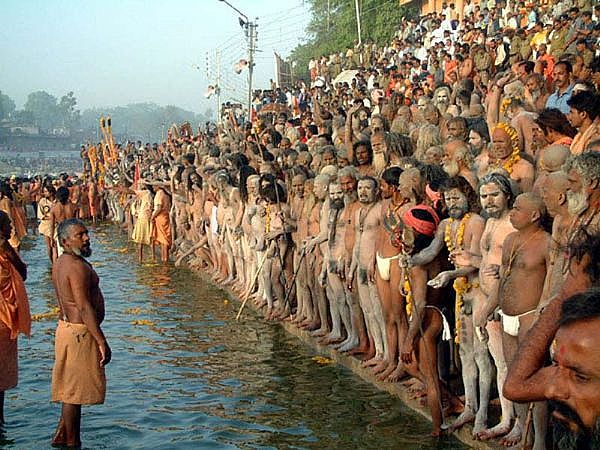
Ujjain is most famous for the Holy Kumbh Mela that is held here every twelve years. The festival is celebrated on the banks of River Shipra which is considered a very sacred river. According to Hindu mythology, after the ocean churning by Gods and Demons, there was a mad tussle between them for the nectar that came out of the ocean. The Demons violently chased Gods for the nectar,and in this process few drops of nectar fell on earth at Haridwar, Nasik, Prayag and Ujjain. Kumbh Mela is held at all these places at different times. During the fair, the city is crowded by overwhelming number of pilgrims and sadhus (Saints).
Bade Ganeshji Ka Mandir is situated near the tank of Mahakaleshwar Temple. The temple is dedicated to Lord Ganesha who is believed to be the God of health and prosperity. The temple is famous for the massive and grand statue of Lord Ganesh.It is one of the largest statues of Lord Ganesha in India. There is also a Panchmukhi image of Lord Hanuman in the middle of the temple.
This temple is dedicated to Lord Shiva.This temple consists of one of 12 Jyotirlingas of Lord Shiva. The temple is divided into 5 levels. One of these levels is underground. The way to this section of the temple is lit up with Brass lamps.
Vikram Kirti Mandir serves as the cultural center to immortalize the memory of King Vikramaditya. The center also has the Scindia Oriental Research Institute that has more than 18,000 rare manuscripts in different fields, an archaeological museum, an art gallery and an auditorium. It was established on the occasion of second millennium of Vikram era.
The caves are situated just above the banks of River Shipra near Gadhkalika Temple. The caves are famous as the place where the step brother of King Vikramaditya meditated after renouncing all worldly possessions and relations.The name of the saint was Bhartrihari, thus the caves too got this name. It is said that Bhartrihari was a great scholar and a talented poet.
This historical palace is situated at a distance of 8 km from the town on an island in Shipra river. The palace was built by Mandu Rulers in the year 1458. Kailadeh Palace was built in Persian style of architecture.
Fairs and Festivals
Almost all the major Hindu festivals are celebrated here. Having one of the 12 Jyotirlingas, Maha Shivratri is a big event here. Thousand of pilgrims flock to the fair grounds near the Mahakal temple to worship Lord Shiva.The Simhastha Kumbh Mela is a mammoth fair held once in twelve years. The magnificence of the bathing ritual is seen at its best during this fair at Ujjain.
How to Reach Ujjain
The nearest airport is at Indore,55km distance from Ujjain.The airlines from this aiport is connected to Bhopal, Bombay,Delhi and Gwalior.
Ujjain is an important railway station on the Western Railway network and connected with most of the major cities in India.
Plan your visit
A useful journey leaves room for local discoveries. Start with these essentials, then verify operational details from primary sources.
Pick a few nearby cities or landmarks rather than trying to cover a whole state in one short trip.
Compare temperature, rainfall and festival periods for the specific part of the region you will visit.
Include time for food, museums, crafts and the places that matter to local communities.
Confirm transport, permits, accommodation and opening dates directly from reliable sources.
Photos and places to remember



More journeys to discover


Frequently asked questions
What is Ujjain known for?
Ujjain is explored in this guide through its local heritage, visitor attractions, culture and images. The highlights and linked articles below offer starting points for your itinerary.
How should I plan a first visit to Ujjain?
Choose a few nearby highlights in Ujjain, group them by area and allow flexibility for travel, meals and rest. Confirm the latest access information with official providers.
When is the best time to visit Ujjain?
The most comfortable time depends on local weather, festivals and your planned activities. Check current seasonal forecasts and any attraction-specific closure notices for Ujjain.
Where can I confirm ticket prices and opening times in Ujjain?
Check the official tourism authority or the individual venue before departure. This page intentionally does not repeat potentially outdated prices or hours.
Is this Ujjain guide updated?
This page was rebuilt from legacy IndiaCityTrip content on October 23, 2026. Older descriptive material has been reorganized; operational details still require direct verification.