Exploring Manas Tiger Reserve
Manas is located along the Indo-Bhutan border with contiguous wildlife habitats in Bhutan. Manas Sanctuary was established in 1928. Prior to that the Raja of Gauripur and the Cooch-Behar royal family used Manas as their hunting grounds. The area was declared a National Park in 1990.
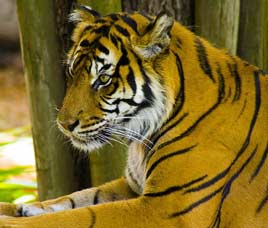
While Kaziranga is known for the Rhinoceros, Manas National Park is famous for the Majestic Tigers. This park is the only Project Tiger in Assam. The Manas Reserve, located in the foothills of the Bhutan hills, far from human habitation, is a world in itself.
The Manas River flowing through the Park demarcates the border between India and Bhutan. The Park has vast deciduous forests where the dense cover often cuts out the light. Its wet grasslands are the home of the rhino, water buffalo, elephant and tiger. Manas is noted for its population of the rare golden langur - found only in this part of the country. They are often spotted in the tall trees. Other primates in the Park include the capped langur, Assamese macaque, the slow loris and the hoolock gibbon. These are rarely seen but the whooping call of the hoolock gibbon can be heard resounding through the forest. The Reserve is also home to the attractive red panda but these are only seen occasionally in the higher elevations.
Manas has a very special biosphere, for it harbours twenty species of birds and animals that are highly endangered and listed in the IUCN Red Data Book. These include the hispid hare and the pigmy hog. The lush forest canopy at Manshelters colourful birds - the giant hornbills, both pied and gray varieties, pheasants, jungle fowl and scarlet minivet being among them. The water-birds along the rivers include brahminy ducks, mergansers and a range of egrets, herons and pelican Over 2840 sq. km. in area, Manas is, a fascinating tiger reserve.
The area of Manas has roughly 45% grassland and 55% tree land as wildlife habitat. The river course may have about 100 sq.km. of riparian forests of grass and primary succession of tree cover, which is probably the most suitable water buffalo habitat anywhere and providing by far the best habitat for the tiger, where the concentration of the species is the highest. Inter and inter specific relation of the prey and predator in this area is extremely interesting and awaits scientific study to understand population dynamics and other evolutionary processes at work. In this area the ever changing river course cause erosion and accretion at the same time providing extraordinary dynamism to the habitat/ecosystems sustaining very high productivity. The rain fall in this area is very high about 450 to 500 cm and the temperature is also very conducive to add to the productivity.
By rail : The nearest town and rail-head is Barpeta Road, 41 kms away. Manas Tiger Reserve
By Road : Manas is well connected by network of roads which connect the place with other indian cities and towns in the state.
Plan your visit
A useful journey leaves room for local discoveries. Start with these essentials, then verify operational details from primary sources.
Reserve any permitted safari or access through the authorized wildlife authority.
Keep a respectful distance, avoid loud noises and never feed or approach wildlife.
Bring neutral clothing, water, suitable sun protection and binoculars if useful.
Check the open season, gate location, guide requirements and changing conservation rules.
Photos and places to remember
More journeys to discover
Frequently asked questions
What is Manas Tiger Reserve known for?
Manas Tiger Reserve is explored in this guide through its local heritage, visitor attractions, culture and images. The highlights and linked articles below offer starting points for your itinerary.
How should I plan a first visit to Manas Tiger Reserve?
Choose a few nearby highlights in Manas Tiger Reserve, group them by area and allow flexibility for travel, meals and rest. Confirm the latest access information with official providers.
Can I visit Manas Tiger Reserve throughout the year?
Not necessarily. Wildlife areas can close for monsoon periods, conservation measures or operational reasons. Confirm current permits, zones and visitor seasons directly with park authorities.
Where can I confirm ticket prices and opening times in Manas Tiger Reserve?
Check the official tourism authority or the individual venue before departure. This page intentionally does not repeat potentially outdated prices or hours.
Is this Manas Tiger Reserve guide updated?
This page was rebuilt from legacy IndiaCityTrip content on October 23, 2026. Older descriptive material has been reorganized; operational details still require direct verification.